Tuesday, November 30, 2010

Did NASA Discover Alien Life In Our Solar System?

On Thursday NASA is bringing together a geologist, an oceanographer, a biologist, and an ecologist for a press conference  to talk about an astrobiology discovery that 'will impact the search for evidence of extraterrestrial life, according to the article below. Sounds pretty important. I have included the official media advisory from NASA below the article. They seem to be hinting at alien life in our solar system.
    . . . June

----------------------------
Is NASA about to announce the discovery of extraterrestrial life?:


NASA is bringing together a geologist, an oceanographer, a biologist, and an ecologist for a press conference on Thursday to talk about an astrobiology discovery that 'will impact the search for evidence of extraterrestrial life.' Yeah, this could be major.

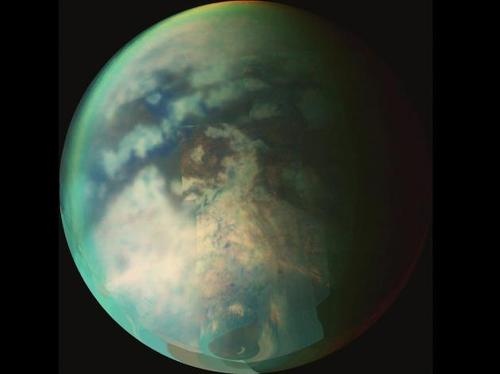
Blogger Jason Kottke did some inspired sleuthing regarding what Thursday's press conference might be about. He discovered the expertises of the various people involved include the interaction of geology and life on alien planets (specifically Mars), photosynthesis using arsenic, Saturn's moon Titan as an early Earth environment, and the chemistry of life, including in places without carbon, water, or oxygen.

Taking that all together and combined with the current blitz of news from NASA's Cassini probe around Saturn, Kottke guesses the announcement might have something to do with the discovery of arsenic on Titan and, quite possibly, some primitive bacterial form of life using it for photosynthesis.

Considering NASA's claim that this will impact our search for alien life, I'd have to figure this has something to do with expanding the definition of "life as we know it", suggesting more elements than we previously thought possible can be used as the raw materials for life. All this, of course, is just speculation - we'll be listening in to the press conference on Thursday and have the news for you as it breaks.


Read entire article

-----------------------------------

NASA MEDIA ADVISORY : M10-167

 
WASHINGTON -- NASA will hold a news conference at 2 p.m. EST on Thursday, Dec. 2, to discuss an astrobiology finding that will impact the search for evidence of extraterrestrial life. Astrobiology is the study of the origin, evolution, distribution and future of life in the universe.

The news conference will be held at the NASA Headquarters auditorium at 300 E St. SW, in Washington. It will be broadcast live on NASA Television and streamed on the agency's website at http://www.nasa.gov.

Participants are:
-     Mary Voytek, director, Astrobiology Program, NASA Headquarters, Washington
-     Felisa Wolfe-Simon, NASA astrobiology research fellow, U.S. Geological Survey, Menlo Park, Calif.
-     Pamela Conrad, astrobiologist, NASA's Goddard Space Flight Center, Greenbelt, Md.
-     Steven Benner, distinguished fellow, Foundation for Applied Molecular Evolution, Gainesville, Fla.
-     James Elser, professor, Arizona State University, Tempe

Media representatives may attend the conference or ask questions by phone or from participating NASA locations. To obtain dial-in information, journalists must send their name, affiliation and telephone number to Steve Cole at stephen.e.cole@nasa.gov or call 202-358-0918 by noon Dec. 2.

For NASA TV streaming video and downlink information, visit:  http://www.nasa.gov/ntv

-------------------------------------

Wow! Sounds intriguing doesn't it?  Of course, life somewhere other than on earth is not all that unexpected, so why not?  Do you believe that there could be life that close to home?  Please leave a comment.

June

---------------------------

Sunday, November 21, 2010

FASTSAT - Scientific Laboratory For Research In Space

FASTSAT - NASA's Fast, Affordable, Science and Technology Satellite has been successfully launched from the Kodiak Launch Complex in Kodiak Island, Alaska on Friday, according to the following article.Apparently, the microsatellite which weighs just under 400 pounds, will serve as a scientific laboratory containing all the resources needed to carry out scientific and technology research operations for the mission time period.
    . . . June

-----------------
NASA Launches Newest Microsatellite In Alaska
Space News Story - WESH Orlando:


FASTSAT To Serve As Scientific Laboratory For Research In Space


"HUNTSVILLE, Ala. -- NASA's Fast, Affordable, Science and Technology Satellite has been successfully launched from the Kodiak Launch Complex in Kodiak Island, Alaska on Friday.

Project manager Mark Bordeaux said the FASTSAT was launched aboard a Minotaur IV rocket at about 7:25 p.m. CST and entered low-earth orbit 406 miles of Earth approximately 22 minutes later.

“This milestone is a testament to our FASTSAT team that worked tirelessly to design, build and test a fully functional, low-cost satellite in a year,” Bordeaux said.

Bordeaux said the microsatellite FASTSAT, which weighs just under 400 pounds, will serve as a scientific laboratory containing all the resources needed to carry out scientific and technology research operations for the mission time period.Bordeaux said the spacecraft and six on board atmospheric and technology demonstration experiments will go through an on-orbit commissioning phase for the first 11 days. The next 180 days will be focused on science operations before an additional characterization of the spacecraft will be performed to test additional flight objectives.

Read entire article

--------------------------

Tuesday, November 9, 2010

A MYSTERY MISSILE Over Southern California?

There appeared to be a missile launch near Los Angeles as a mysterious object was spotted over the Southern California sky, according to the article below. Apparently, no one in the Pentagon knew exactly what it is as there was no planned military launch. Was is actually a missile - or will it turn out to be something else quite mundane?
    . . . June

-------------------------------------
Mystery Object No Threat to Nation:
NORAD | NBC San Diego: By R. STICKNEY Updated 3:54 PM PST, Tue, Nov 9, 2010

What appeared to be a missile launch near Los Angeles Monday night may be something entirely different as military and aviation agencies and experts chime in on the mysterious object spotted over the Southern California sky.

A local television station showed video captured by a traffic helicopter around sunset. The location was reported to be west of Los Angeles, north of Catalina Island and approximately 35 miles out to sea, KFMB reported.

It does appear a substantial object left a large contrail over Southern California Monday evening but no one in the military has identified the object, NBC News Pentagon correspondent Jim Miklaszewski reported Tuesday morning.

No one in the Pentagon knew exactly what it is.

It cannot be a planned military launch because no branch had a military action planned, according to Miklaszewski.

A possibility is that the missile was launched unintentionally. It may have been a screwup. Someone may have simply punched the wrong button.

Vandenberg Air Force Base officials said the facility's last launch was a satellite on Friday. Naval Base Ventura County spokeswoman Teri Reid told the LA Timesy that the contrail did not originate at Naval Air Station Point Mugu.

"It didn't happen here," she told the Times. "There was no firing on the range yesterday."

Another possibility would be a sophisticated launch just to create a spectacular sight in the sky.

Read More

---------------------------

I personally think someone pushed a button by mistake and doesn't want to admit it. What do you think it really was? Leave a comment.

June

----------------------


Friday, November 5, 2010

NASA Wants Hypersonic Jets that Travel at 5 X Speed of Sound

The US space agency wants to manufacture an aircraft that would travel at five times the speed of sound and bring in a new age of aircraft akin to a turbo-charged Concorde, according to the article below. Travelling at such speed would reduce the flight time from New York to Sydney to around two-and-a-half hours, from the 21 hours it is now. In a way, it's a wonder it hasn't already happened. The technology is now here.
    . . . June

-------------------------------------
Nasa to develop 'hypersonic' jets that travel at 5 times the speed of sound
Mail Online:

NASA is planning to build hypersonic jets that will fly through the Earth’s atmosphere and slash flight times around the world to a few hours at most.

The US space agency wants to manufacture a craft that would travel at five times the speed of sound and bring in a new age of aircraft akin to a turbo-charged Concorde.

Travelling at such speed would reduce the flight time from New York to Sydney to around two-and-a-half hours, from the 21 hours it is now.

The project is thought to be aimed at making a reusable aircraft that could fly to Mars but, as with previous space technology, it could have a huge impact upon passenger transport too.

Under the NASA Aeronautics 2010 proposal, the space agency will allocate $5million per year for the next three years to make the new aircraft a reality.

The aim is to create something which can carry passengers through the atmosphere, descend and land safely before being reused.

According to the proposal, engineers will look into ‘entry, descent and landing of high-mass vehicles entering into planetary atmospheres’ and ‘airbreathing access to space’
NASA is also aware of the many challenges it faces to build such a machine.

The proposal says: ‘The hypersonic heating environment, coupled with the emphasis on reusability, creates additional severe technology challenges for materials, material coatings, and structures that not only carry the aerodynamic loads of the air but also repeatedly sustain high thermal loads requiring long-life and durability while minimizing weight.

‘Space access launch vehicles must be lightweight, fully reusable and easily maintained if low-cost access to space is to be achieved.’

Hypersonic aircraft is still a fairly new concept and follows on from Concorde, which flew at Mach 2, or twice the speed of sound.

A hypersonic aircraft would reach Mach 5, or five times the speed of sound.


Read more: 

-----------------------------------------

Thursday, October 28, 2010

DEEP IMPACT Spacecraft Will Fly By Comet Hartley On Nov. 4

After a voyage of years, the Deep Impact spacecraft will fly by Comet Hartley on Nov. 4, according to the following article. This  will give scientists clues to the early days of the solar system.This is Deep Impact's second comet encounter after serving as the mother ship for NASA's Deep Impact mission

    . . . June

----------------------------------
NASA prepares for comet fly-by

UPI.com: "WASHINGTON, Oct. 27 (UPI) -- NASA is preparing for next week's encounter between its Deep Impact spacecraft and a comet, set to pass within 500 miles of each other, the agency says.

After a voyage of years, the spacecraft will fly by Comet Hartley on Nov. 4, SPACE.com reported.

The near-miss, only the fifth time close-up images of a comet will be captured, will give scientists clues to the early days of the solar system.

Around 2,000 images of the comet have been beamed back to Earth every day since Oct. 1, researchers said.
This is Deep Impact's second comet encounter after serving as the mother ship for NASA's Deep Impact mission, which intentionally sent a probe to crash into Comet Tempel 1 in 2005 to study the object's composition.
The spacecraft has covered about 3.2 billion miles since its January 2005 launch and is approaching Comet Hartley 2 at speeds of about 27,000 mph, NASA says.
Read more

Saturday, October 16, 2010

LUTETIA - Huge Asteroid in A Thick Dust Blanket

 Outer Space is still virtually an unknown entity. Every day new worlds are being uncovered as the technology improves. New planets, moons and asteroids are being identified and named on a daily basis, for example, an asteroid named Lutetia. According to the following article, a trip to Lutetia may be very uncomfortable. Read on . . .
     . . . June


-----------------------
Huge Asteroid Wrapped in Thick Dust Blanket
Yahoo! News:

If astronauts ever visit the asteroid Lutetia, they may have to strap on snowshoes to avoid sinking into its nearly half-mile-thick layer of dust.

Dusty debris shrouds the huge asteroid to a depth of at least 2,000 feet (600 meters), scientists have calculated. The dust probably resembles the regolith found on the moon, and it's a result of the intense cosmic pummeling Lutetia has endured from other space rocks since the birth of the solar system.

'It must have been produced by impacts,' said Rita Schulz of the European Space Agency in a media briefing yesterday (Oct. 4) in Pasadena, Calif. The announcement came at a conference organized by the American Astronomical Society's Division of Planetary Sciences.

The new look at Lutetia, which is located in the asteroid belt between Mars and Jupiter, is the result of a close fly-by made by ESA's Rosetta spacecraft in July. Rosetta, whose chief task is chasing down and studying a comet, zoomed to within 1,900 miles (3,162 km) of Lutetia, making it the largest asteroid ever to be visited by a space probe.

Rosetta snapped some detailed photos and probed the space rock from afar with a suite of instruments. The data confirmed that Lutetia is an elongated body with its longest side spanning approximately 81 miles (130 km), ESA officials have said.

But it took some time for scientists to process and analyze much of Rosetta's data. Over the last few months, they scrutinized some of Lutetia's many craters, measuring how deep they are. Researchers then compared that information with predictions of how deep such craters are expected to be based on theoretical models.

The craters were much shallower than researchers had anticipated, Schulz said, because of the thick layer of dusty debris. Indeed, one of Rosetta's most dramatic photos shows a landslide of dust at the bottom of an enormous crater.


Read entire article


-----------

VIRGIN GALACTIC Spaceship Makes First Solo Test Flight

A private spaceship flew its first solo test flight on Oct. 10 from Mojave Air and Space Port in California, according to the following article. Though the craft did not reach space, it was a major milestone for SpaceShipTwo backed by billionaire Richard Branson, establishing the Virgin Galactic firm to offer passengers suborbital treks at $200,000 a seat. Wow! Just like in  the movies!
     . . . June

-------------------------
Virgin Galactic's Private Spaceship Makes First Solo Glide Flight
Yahoo! News: "SPACE.com Leonard David

A private suborbital spaceship flew its first solo test flight today (Oct. 10) from Mojave Air and Space Port in California.

Though the craft did not reach space, it was a major milestone for the Virgin Galactic SpaceShipTwo, which flew in glide mode for some 15 minutes once released from its carrier plane, WhiteKnightTwo, according Bill Deaver, an eye-witness of the test flight.

'It was perfect landing,' Deaver told SPACE.com. 'It looked just spectacular.'

Once released from the huge mothership, two pilots controlled the SpaceShipTwo to a safe runway touchdown

Designed to carry six ticket-holding passengers, the suborbital spaceship is named VSS Enterprise. U.K. billionaire Richard Branson is backing the development of the spaceliner, establishing the Virgin Galactic firm to offer passengers suborbital treks at $200,000 a seat. To date, over 340 people have signed-up for flights to the edge of space
.
There has been a steady progression of testing of the vehicles over the last several months. For example, for the first time on July 15, VSS Enterprise flew with crew on board.

The first WhiteKnightTwo, christened VMS Eve after Richard Branson's mother, was revealed to the public for the first time in July 2008 and started its test flight program later that year.

As planned for that test last July, the spaceship remained attached to its carrier plane -- VMS Eve -- for the duration of the flight, and numerous combined vehicle systems tests were conducted. Also in that flight, the two crew members on board VSS Enterprise evaluated all of the spaceship's systems and functions from end to end in the air.

Read entire article


-----------